India’s aviation sector is experiencing one of the most significant structural transformations in its history, driven by rising middle-class aspirations, improved airport infrastructure, and the ambitious 100 new airports UDAN regional connectivity programme. India is expected to become the world’s third largest air passenger market by 2030 targeting 300 million passengers annually. As of FY26, IndiGo has a market share of approximately 64 percent in India’s domestic aviation segment and has become the 8th largest airline in the world by daily departures with 440 plus aircraft. The Air India Group commanded approximately 22 percent combined capacity share in June 2026 through its Air India and Air India Express brands. In April 2026, domestic air traffic fell 4 percent year-on-year to 140.8 lakh passengers as West Asia conflict forced IndiGo to cut 17 percent of international capacity. Let us have a look at the top 10 airline companies in India for the year 2026.
1. IndiGo (InterGlobe Aviation Limited)
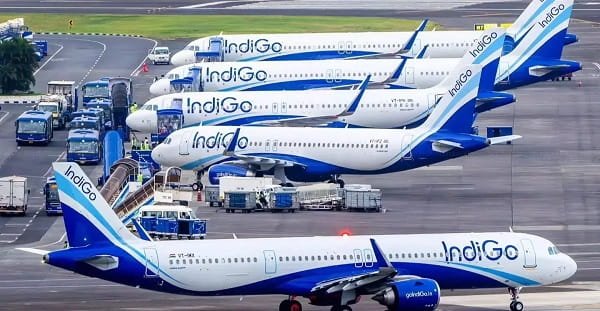
IndiGo, established by Rakesh Gangwal and Rahul Bhatia in the year 2005 and headquartered in Gurugram, is India’s largest airline by a massive margin with a domestic market share of approximately 64 percent and a market capitalisation of Rs 1,94,160 crore, having become the 8th largest airline in the world by daily departures with 440 plus aircraft. The airline commenced operations on August 4, 2006 and became India’s largest carrier by 2012. CEO Pieter Elbers resigned on March 10, 2026 following a December 2025 scheduling crisis, with Irish aviation executive Willie Walsh named as new CEO on March 31, 2026.
IndiGo serves over 90 million domestic passengers annually across 94 domestic and 43 international destinations with its low-cost, high-frequency model built on fleet uniformity and cost discipline that made it the first Indian airline to cross the billion-dollar profit mark in FY24 with Rs 8,172 crore net profit.
2. Air India Limited (Tata Group)
Air India, originally established in the year 1932 by J.R.D. Tata as Tata Airlines and re-acquired by the Tata Group in January 2022 after decades of government ownership, is India’s second largest airline with a 12 percent capacity market share in June 2026 with 2.8 million seats operated. The airline has undergone intensive modernisation including ordering 470 aircraft from Boeing and Airbus in the largest aircraft order in commercial aviation history, refreshing cabin interiors, and recruiting international aviation talent.
Air India serves business travellers, premium leisure passengers, and international travellers with its full-service airline model, and its Tata Group ownership has brought renewed investment, international management expertise, and the financial commitment to transform India’s legacy national carrier into a competitive world-class full-service airline.
3. Air India Express (Tata Group)
Air India Express, a wholly owned subsidiary of Air India operating as a low-cost carrier and part of the Tata Group’s airline portfolio, serves point-to-point domestic and short-haul international routes particularly between South India and the Gulf region. The airline remains a significant player in the South India-Gulf corridor that carries tens of millions of Indian migrant workers and their families annually, with the merger of Air India Express with AIX Connect strengthening its position in the low-cost domestic market.
Air India Express serves price-conscious domestic travellers and the India-Gulf traveller segment with its low-cost point-to-point route network, and its strategic importance within the Air India Group lies in competing with IndiGo and SpiceJet for budget travellers while parent Air India focuses on premium full-service travellers.
4. Akasa Air (SNV Aviation Private Limited)
Akasa Air, launched in the year 2022 by Rakesh Jhunjhunwala and co-founders and headquartered in Mumbai, has grown impressively to capture approximately 5 percent domestic market share in May 2025, continuing expansion in 2026. The airline increased capacity by 12 percent versus June 2025 to 916,000 seats — the fastest capacity growth rate among all Indian carriers in June 2026 — targeting tier-2 and tier-3 cities with value pricing and its all-Boeing 737 MAX fleet among the newest in Indian aviation.
Akasa Air serves budget-conscious domestic travellers particularly in tier-2 and tier-3 cities with its young, fuel-efficient fleet and aggressive expansion strategy, and its strong early growth momentum validates the opportunity for a new well-capitalised entrant to carve out a sustainable niche in India’s competitive aviation market.
5. SpiceJet Limited
SpiceJet, one of India’s established low-cost carriers and founded in the year 2005 as the rebranded Royal Airways, is regarded as a turnaround play in 2026 following a challenging period of operational and financial difficulties that led to significant aircraft grounding and flight reductions. The airline has been gradually rebuilding by wet-leasing aircraft, negotiating debt settlements, and returning aircraft to service as it works to restore its position in India’s competitive budget airline market.
SpiceJet serves domestic budget travellers with its low-cost carrier model and is working to rebuild operational capacity and financial stability after a challenging period, representing the volatile and capital-intensive nature of India’s airline industry where even established brands face existential operational challenges.
6. Star Air (Sanjay Ghodawat Group)
Star Air, owned by the Sanjay Ghodawat Group and launched in the year 2019, is one of India’s significant regional airlines operating under the UDAN scheme to connect smaller cities and towns poorly served by larger commercial carriers. The airline operates the Embraer ERJ-145 regional jet and focuses on connecting tier-2 and tier-3 Indian cities with metro hubs, playing an important role in democratising air travel access beyond the larger airports served by IndiGo and Air India.
Star Air serves passengers in smaller Indian cities seeking connectivity to major hubs without requiring travel to larger nearby airports, and plays a socially important role in expanding air travel access to communities in tier-2 and tier-3 cities as part of India’s UDAN regional connectivity initiative.
7. Fly91 (Zillious Solutions)
Fly91, based in Goa and operating under the UDAN regional connectivity scheme, is one of India’s newest regional airlines targeting underserved tier-2 and tier-3 cities in western and central India. The airline represents the growing class of India-specific regional carriers where UDAN’s subsidised ticket pricing makes air travel economically accessible for the first time, expanding India’s aviation consumer base beyond the urban middle class.
Fly91 serves passengers in western and central Indian tier-2 and tier-3 cities with its regional connectivity operations, and represents the government’s UDAN scheme in action — bringing air travel access to communities that have historically been dependent on long train or road journeys to reach major Indian metros.
8. IndiGo CarGo
IndiGo CarGo, the air freight arm of IndiGo operating as a subsidiary of InterGlobe Aviation, has been expanding cargo operations as air cargo growth in India runs at approximately 15 percent annually. The company leverages IndiGo’s existing belly cargo capacity across its extensive domestic and international network and is developing dedicated freighter operations to serve the rapidly growing e-commerce and pharmaceutical logistics markets requiring reliable time-definite air cargo services.
IndiGo CarGo serves e-commerce companies, pharmaceutical exporters, and high-value shipment customers with its growing air freight network built on IndiGo’s passenger fleet belly cargo foundation, representing the most natural extension of IndiGo’s aviation infrastructure into the high-growth air cargo segment.
9. Alliance Air
Alliance Air, which traces its history to the year 1996 as a regional subsidiary of Air India before being separated, operates as a regional carrier serving underserved routes particularly in Northeast India, Jammu and Kashmir, and other geographically challenging areas where conventional commercial aviation economics are difficult without government support. The airline plays an important role connecting remote communities to India’s larger airline network.
Alliance Air serves passengers in remote and geographically challenging regions of India including the Northeast, Jammu and Kashmir, and Andaman and Nicobar Islands with its regional route network that extends air connectivity to communities with extremely limited transport options otherwise.
10. Air India One (Government Charter Service)
Air India One, the Indian government’s official VIP and diplomatic air transport service operated by Air India through Boeing BBJ aircraft designated for Presidential and Prime Ministerial travel, serves India’s constitutional and government travel requirements at the highest international standards. This dedicated government aviation arm ensures continuity of official air transport for India’s senior constitutional officers on domestic and international travel.
Air India One serves the highest-level functions of Indian government and diplomatic travel, ensuring that India’s President, Prime Minister, and other senior constitutional officers have access to appropriately equipped air transport for official travel requirements both within India and internationally.
Frequently Asked Questions (FAQs)
Q: Which is the largest airline in India in 2026?
A: IndiGo is by far the largest airline in India with a domestic market share of approximately 64 percent and a fleet of 440 plus aircraft, making it the 8th largest airline in the world by daily departures. The Air India Group holds the second position with approximately 22 percent combined capacity share through Air India and Air India Express.
Q: What is the state of Air India’s transformation in 2026?
A: Air India is undergoing intensive transformation under Tata Group ownership since January 2022. The airline placed the largest aircraft order in aviation history with 470 new Boeing and Airbus jets, is refreshing cabin interiors, and has recruited international aviation management. Air India’s combined capacity share with Air India Express stands at approximately 22 percent in June 2026, though profitability remains a challenge as transformation investment is substantial.
Q: Who is IndiGo’s new CEO in 2026?
A: Willie Walsh, the former Director General of IATA and respected Irish aviation executive with previous leadership at British Airways and IAG, was named IndiGo’s new CEO on March 31, 2026, following the resignation of previous CEO Pieter Elbers on March 10, 2026, after IndiGo’s December 2025 scheduling crisis.
Q: What is India’s UDAN scheme and how is it changing Indian aviation?
A: UDAN or Ude Desh Ka Aam Nagrik is a regional air connectivity scheme launched by the Government of India to make air travel affordable and accessible for citizens in tier-2 and tier-3 cities. The scheme subsidises airfares on specific routes connecting smaller cities to major hubs, with 100 new airports being developed across India. Airlines like Star Air, Fly91, and Alliance Air serve communities that previously had no air connectivity, dramatically expanding India’s aviation addressable market.
Q: Why is Indian aviation still challenging despite strong passenger growth?
A: India’s airline industry is structurally challenging due to among the world’s highest aviation turbine fuel taxes that keep operating costs elevated, intense price competition forcing airfares down, infrastructure constraints at major airports causing delays and high turnaround costs, weak yields on domestic routes where passengers are extremely price-sensitive, and high fixed costs with volatile demand. More than 25 Indian airlines have shut down since liberalisation, with Kingfisher, Jet Airways, and Go First being the most significant recent casualties.